Dwarves
Origins
According to legends, the now-extinct Giants were the original inhabitants of Lythria. In ancient times, one faction of Giantkind devoted itself wholly to Titanos, their mountain god. Seeking easier passage into the deepest reaches of the earth, they performed a sacred ritual that diminished their tremendous size. Smaller bodies could pass through narrower tunnels, require fewer resources, and delve more efficiently toward the hidden riches below. Ages later, the stout, stalwart, beard-braiding Dwarves of the deep claim to be descendants of that transformed Giant lineage.
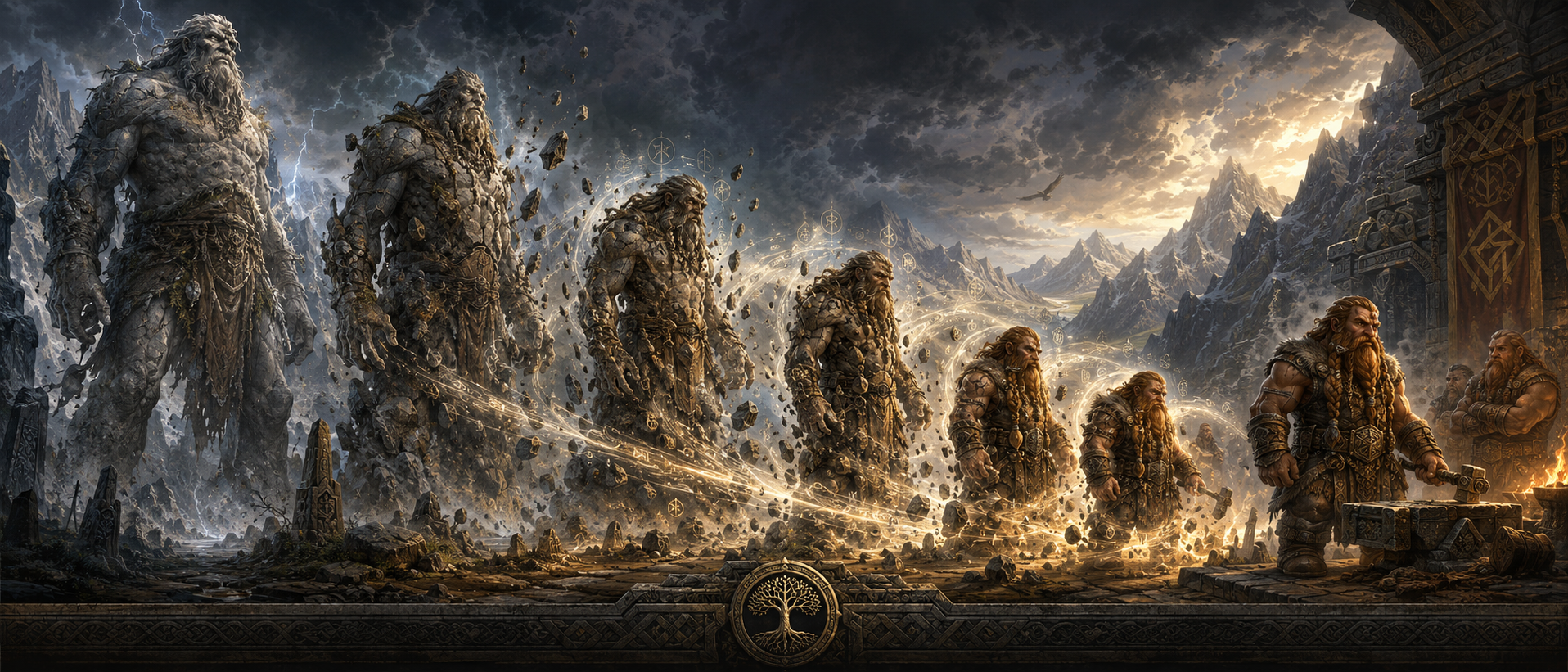
Not everyone accepts this account. Some dismiss it as a fanciful tale invented by a small people attempting to magnify their importance. Others regard it as genuine ancient history, though they interpret the transformation as a self-inflicted curse that reduced a once-mighty people to a shadow of their former stature. Dwarves themselves rarely consider their size a loss. Where Giants possessed immensity, Dwarves claim to have inherited endurance, discipline, craft, and an intimate understanding of the earth.
For generations, much of Dwarven civilization flourished beneath the surface in the great subterranean city of Thrandom. Its halls, mines, forges, and homes extended deep into the stone, forming the cultural heart of Dwarven society. Thrandom was eventually destroyed when a tremendous earthquake caused much of the city to collapse. Those who escaped became known as the Refugees of Thrandom. Many found shelter among the Humans of Everholm, creating an alliance born as much from necessity as friendship.
Culture

Dwarven culture values craftsmanship, household loyalty, self-reliance, and practical contribution. Mining holds a particularly honored place within their society, and Dwarven children are raised to understand stone, tunnels, metals, gems, and the dangers of the deep. A Dwarf who cannot mine is often compared to a fish that cannot swim.
Traditionally, Dwarven settlements are built within caves, mountains, and vast underground caverns, allowing their people to delve ever deeper in search of precious metals, gems, forgotten ruins, and lost passages.
The destruction of Thrandom continues to shape the identity of its refugees. Living within Human-controlled lands, they carry both the grief of a fallen homeland and the pressure to remain useful within Everholm. Though mining and craftsmanship were already central to Dwarven life, the Refugees of Thrandom have placed even greater emphasis on precision, Coordination, and specialized trades. Their skill as miners, builders, engineers, artisans, and smiths helps preserve their political influence and a measure of independence.
Dwarves are not bound to these traditional paths. Some become sailors, traders, minstrels, mercenaries, priests, explorers, or adventurers. Whatever their calling, few lose their appreciation for precious metals, fine gems, and strong ale, with the darkest and stoutest brews held in highest esteem.
Religion
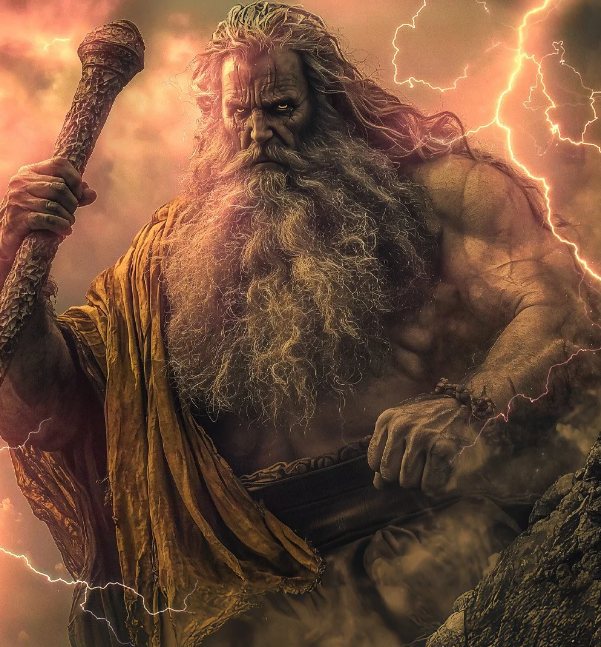
Titanos is believed to be the progenitor of both Giantkind and Dwarvenkind, and he remains the primary deity of most Dwarves. He is honored as the lord of mountains, stone, endurance, and the riches hidden beneath the earth. Lythria herself is revered as their mother and the divine consort of Titanos. The quaking of the earth is said to mark their lovemaking, while the veins of ore running through the stone are believed to be the seed of Titanos planted within her.
This belief shapes the Dwarven approach to mining. Lythria is generous and nurturing, offering great bounty to those who approach her with patience and skill, but she is also dangerous when disrespected or taken for granted. Mining is therefore treated as both courtship and negotiation. Greed, carelessness, or arrogance may provoke her wrath, while respect and perseverance are rewarded with the riches hidden beneath the earth. Such comparisons are common in Dwarven humor, where the dangers of mining and romance are frequently treated as nearly identical subjects.
While most Dwarves continue to follow Titanos, some Refugees of Thrandom have begun converting to the Supremian faith. For some, conversion is sincere. For others, it offers greater acceptance, opportunity, or political influence among the Humans of Everholm. This growing religious divide has introduced tension within Dwarven society. Traditionalists fear that the loss of Thrandom may be followed by the loss of their gods and culture, while converts argue that adaptation is necessary for their people to survive and prosper.
She-Dwarves
Dwarven households are traditionally owned and ruled by their women. The home, its stores, its wealth, and the authority of the hearth belong to the She-Dwarf who maintains them. A male is permitted to remain according to what he contributes, most often companionship, labor, protection, trade, or material bounty. Should he lose her favor, she may cast him out and send him to sleep at the local tavern.

For this reason, most Dwarven taverns maintain barracks-like chambers filled with cots for temporarily unhomed males. Some remain only for a night, while others linger until pride gives way to loneliness, discomfort, or a desire to regain the favor of the woman whose home they shared. When affection remains strong, a brief taste of tavern life is often enough to inspire reconciliation.

She-Dwarves are generally less inclined to wander than their male counterparts, as many take great pride in ruling their hearth and family with an iron spoon. A prosperous, orderly household is regarded as a visible demonstration of competence and strength, not a lesser calling than adventure. Even so, some She-Dwarves leave home to pursue wealth, battle, craftsmanship, reputation, or discovery. Though unusual, such women are accepted, particularly when they return with impressive stories, rare materials, or considerable treasure.
Slavery
Dwarves adopted the practice of slavery reluctantly, primarily to navigate the customs and laws of their Human allies. Most would rather perform their own labor and fight their own battles. Some She-Dwarves even choose to serve as milk producers themselves rather than maintain a slave for that purpose, though the practice remains uncommon.
Those Dwarves who do own slaves tend to treat them more humanely than Human law requires. Dwarven-owned slaves are generally kept well-fed, protected, and included within the daily life of the household or clan. They may be regarded with an affection similar to that granted to treasured pets or mounts. This treatment does not necessarily mean Dwarves reject slavery as an institution. Rather, they tend to see cruelty, waste, and neglect as signs of poor ownership and weak household management.
Common Dwarven Perspective of the Races
Humans — “Ach… humans are a young folk. Full o’ fire an’ grand notions — but like half-grown bairns they’re drunk on their own importance an’ deaf tae the wisdom o’ ages. They’ll need guidin’, else they’ll never truly walk in the Light.”
Dwarves — “We are the blood o’ the ancient giants, the eldest livin’ folk in Lythria. Never forget the weight o’ that heritage, nor the bond it lays upon us.”
High Elves — “Hah. Uppity dust-heads. For all their learnin’, their own pride blinds ’em tae truth more often than not.”
Wood Elves — “Wardens o’ the woods. Dinnae be swingin’ an axe in their groves, lad — ye’ll find yerself in irons afore ye ken what’s happened.”
Dark Elves — “Aye, desert-born folk wi’ sun-kissed skin an’ good cheer. Fond o’ strong drink, rich fare, an’ fine dwarven craft. Hard tae fault such folk.”
Half-Elves — “Charming bairns o’ two worlds. They’ll hear ye out polite enough, but press them overmuch an’ they’ll slip their leash quiet-like. Win their true trust, though, an’ ye’ll have a loyal blade at yer side.”
Tieflings — “Ach, poor bastards. ‘Twas their mums did the sin. Show compassion, lad, but keep yer wits sharp. There’s a slyness in their blood ye’d do well nae tae forget.”
Goblins — “Minions o’ Depravos, sly an’ venomous as adders. Never trust a goblin, an’ never think one harmless. I’d sooner trust a chained changeling than a grinnin’ gob.”
Orcs — “Respect their strength, for they’re the new giants o’ Lythria, an’ no foe worth dismissin’. But suffer them no mercy, for they’ll grant ye none. Where an orc sees a dwarf, hatred takes the reins.”
Changeling — “Fae-swapped younglings are a cruel jest o’ the Fae buggers. Raised as kin till their true nature shows, an’ the hurt cuts deep as any axe wound. Guard yer heart against such fae meddlin’… yet mind this, lad, the blame isnae always theirs.”