Elves
Elvenkind
The differences between the three types of elves are mostly superficial. Graceful, long lived and ethereal, they value beauty above all else and will fight viciously to protect it. Ancient and wise, they have learned to wield magic in ways that allow more harmony with their environments. Often believed to be protectors of nature, they are more accurately the protectors of nature's beauty. Not as arrogant as humans, elves tend to be more afflicted with vanity. Those enslaved to elves are often expected to be spectacles of living art, or at least maintain certain appearance standards.
Elven Faith

Leylalumina, the Moon Goddess, is the primary deity of all elfkind. She is their Mother, believed to have literally given birth to the elven race. Lythria is her royal garden, and she has sent her children over the Moon Bridge to live in Lythria as its caretakers. The garden provides blessed fruit for the making of wine, a favorite of all elves. Leylalumina sends her children visions through their dreams, and endows her priests and priestesses the power to interpret their meanings. Sigil stones or scrying pools are often employed for this purpose.
High Elves
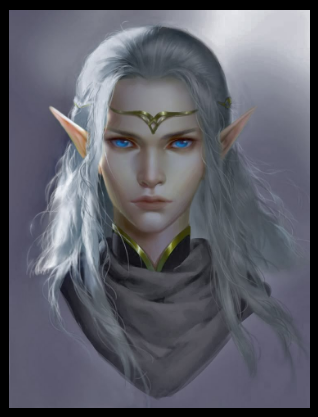
While all of the elves are the caretakers of the garden that is Lythria, one group have set themselves apart as the caretakers of the elves themselves. These fair haired elves of the High Houses have become the elven nobility, dubbed High Elves by the humans. In ancient times, those born with silver or white hair became thought of as most pure and blessed by the moon’s beauty, often being the preferred partners for procreation among the High Houses. This eventually evolved into those of the noble houses having almost exclusively moon colored hair. Silver, white or pale yellow hair are viewed as the most acceptable shades for mates, and courtships take decades. Marriages are often arranged by the families, and love is expected to grow between the newlyweds over time.
Common High Elf Perspectives
Humans — “Earnest seekers of power and understanding, driven by brief lives. They build much, break much, and seldom pause to consider which is which.”
Dwarves — “The dwarves endure, as all things hewn from stone must. Their skill is admirable, though it was dearly purchased. When the last of the giants stepped from shadow to name themselves thus, many ancient dreams were… reduced.”
High Elves — “The High Houses exist to safeguard harmony among elfkind. Through careful unions, measured counsel, and the quiet guidance of generations, we ensure that the garden’s stewards remain worthy of their charge.”
Wood Elves — “Our freer kin tend the forests and jungles with instinct and devotion, preserving a beauty that does not always yield to careful shaping.”
Dark Elves — “Beneath harsher skies our desert kin have shaped lives of striking grace. Their honor is keen, though their resistance to guidance unsettles the harmony we seek.”
Half-Elves — “The High Houses do not forbid such unions, yet we cannot pretend they are without consequence. Half-elven offspring often inherit confusion of place and manner, shaped by environments less attuned to refinement.”
Tieflings — “The infernal-begotten bear the mark of forces that do not belong to this garden, and so we regard them with measured caution. Yet they are not bound as thralls to those distant powers. Where they prove capable of harmony, we do not deny them welcome.”
Goblins — “Goblins are instruments of discord, clever hands that too often disturb the garden’s natural balance. We do not mistake their mischief for innocence.”
Orcs — “Violent custodians of their own brutal order, the orcs answer courtesy with challenge and weakness with ruin. They trouble the garden’s peace, yet even they may be guided by the ancient currency of strength.”
Changelings — “In the matter of changelings, even the Moon’s guidance grows uncertain. What is meant to be tended is instead tested, and trust becomes a fragile thing.”
Wood Elves
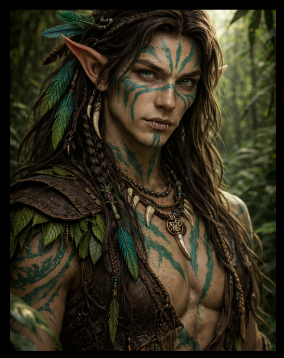
While the High Houses concern themselves with governing, those of the Common Houses devote their lives to the care and protection of the Mother’s garden. They serve as wardens of forests in all their forms, from sunlit groves to dense jungles.
Less bound by formality than their noble kin, Wood Elves are spared the expectations of good breeding. Should a union prove ill-suited, it may be ended without lasting stigma. Their skin and hair coloring often reflects the lands they tend, with hair ranging from honey-blond and sunlit red to deep auburn and rich walnut brown, but pale hair colors are not impossible.
Practical and adaptable, Wood Elves value harmony with their surroundings over adherence to rigid custom. To them, appearance is a tool rather than a measure of worth, altered as needed to build trust, avoid conflict, or better defend the balance they are sworn to keep. Their ways are as varied as the lands they protect, adapting to the fashion and customs of neighboring peoples. A number choose the wandering life of lone wardens or small clan guardians, moving wherever the needs of the forest call them.
Common Wood Elf Perspectives
Mortals (Humans and Dwarves) — “Mortals are guests beneath our canopies. Those who listen and tread lightly are met with goodwill. Those who cut without guidance will find the forest less kind.”
Elvenkind — “All elves are kin. That is enough.”
Half-Elves — “Half-elves walk between paths. If they learn the ways of forest and kin, they are welcome enough.”
Tieflings — “The infernal-begotten are watched first. Trust comes when goodwill is proven.”
Goblins — “Weeds choke young trees if left alone. Goblins are best kept beyond our roots.”
Orcs — “Orcs keep hard ways. Show strength; keep your ground; orcs will honor.”
Changelings — “A nest changed in the night leaves deep wounds. We guard our young and keep wary eyes.”
Dark Elves
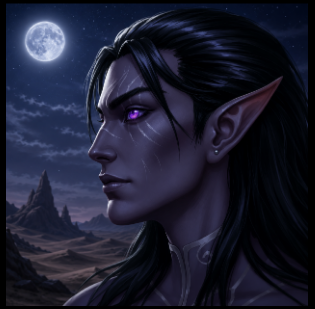
The Dark Elves took to the deserts, seeking to protect the beauty of those strange plants that thrived among the harsh conditions. Within a decade, they had adapted to the heat by shifting to a more nocturnal lifestyle. Still, their time in the sun has darkened their skin to shades of rich brown, dusky purple and even black. Most have dark colored hair, but as they share lineage with the other elves also, pale colors are not abnormal, just uncommon. Their eyes tend to glow from a particular cactus they regularly add to their dishes.
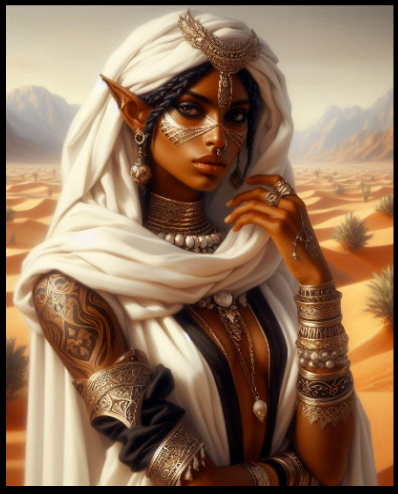
Dark Elves, like Wood Elves, are considered to be of Common Houses, but they do not always recognise the rule of the High Elves. Dark Elves tend to view all Elfkind as the same, regardless of appearances, and every House as equal in duty to the Mother’s Garden.
Dark Elf culture tends to be more like that of the nomads of Arabia, with camels and smaller horses serving as mounts, and tents being the most common shelter. Adobe buildings suffice for more reinforced towns, and one's House is synonymous with one's Honor. Hospitality is a requirement, but so is being a good guest. Of all the elves, Dark Elves are the most open minded, but they are still elves and afflicted with the same tendency toward vanity.
Common Dark Elf Perspectives
Humans — “Human lives burn bright and brief, like campfires upon the dunes. We trade, we laugh, we part. It is best this way.”
Dwarves — “Stonefolk and sandfolk understand one another. We trade craft, stories, and the comfort of shared excess.”
High Elves — “Moonlit halls speak with ancient certainty, and we listen with respect. But the dunes have their own truths. We walk where our judgment leads.”
Wood Elves — “Forest kin are like songs half-forgotten until heard again. Then the feast begins, and memory returns as if it never left. The Moon reminds us we were never truly apart.”
Dark Elves — “We are children of the desert moon, walking where the Mother’s garden dares to bloom in sand and silence. We keep our honor in our word, our welcome in our tents, and our joy in the cups we share beneath the stars.”
Half-Elves — “They are kin beneath the Moon. Our only pity is that they will foster no family.”
Tieflings — “Those that prove honorable are welcome at our fires and in our tents, for they chose not their heritage.”
Goblins — “As clever as jackals and as slippery as cobras, we respect the sharpness of their craft and may trade words and wares. A goblin bargain is best made with open eyes.”
Orcs — “Orcs live by the edge of the blade and the pride of their clans. They respect strength plainly shown and seize swiftly upon weakness. We meet them with steady hands and open eyes, for in harsh lands even rivals may come to understand one another.”
Changeling — “The changeling’s tale is one of loss on every side. We remember they are born of the Moon’s own tangled family, and so we do not spill their blood without grave cause. Yet a trust once broken cannot simply be mended. Those revealed among us are sent away, in hope they find their path beyond our tents. Those who still wander this land must be kept under watchful restraint, for their nature invites mischief and sorrow alike. In time, some learn discipline and purpose… and even earn a place within our households.”